
The 1960s for the NAACP & Wooster and Orrville
Written by Abby Frock. Edited by Jordan Biro Walters, PhD and Elora Agsten, MSLIS.
The NAACP Expands Nationally
In the 1960s, the national NAACP expanded across the U.S. with over 1,000 branches, largely thanks to the support of grassroots organizations. Scholars understand the NAACP’s expansion to grassroots associations to be key to the success of the civil rights organization nationwide. The NAACP thrived thanks to the effort of countless individuals in creating a communication and support network for civil rights activists. Local branches provided communities with a structure from which they could challenge local racial injustices and discrimination. Grassroots organizations had intimate understandings about the intricate needs of local communities that an overarching organization would have struggled to develop. Across Ohio, NAACP branches often confronted housing, voting, and employment discrimination.

An early photo of the NAACP headquarters in Cleveland, Ohio. (Image courtesy of Wikimedia Commons).
Activism in 1960s Wooster Prior to the NAACP

Reverend Leroy Adams and Family (Image courtesy of Wooster Digital History Project).
Before the NAACP, Black activism in Wooster was rooted in Second Baptist Church, Wooster’s first historically Black church. By the 1960s, Reverend Leroy Adams worked towards social justice as the church’s community fought against housing discrimination in Wooster. Black residents faced rampant housing discrimination and red lining, which banks and realtors utilized to prevent minority neighborhoods from receiving bank loans for housing in a majority white town. Second Baptist Church acted as a site of activism that paved the way for the development and success of a community-wide NAACP branch.

“When their neighbors found out [we were Black] they not only protested, they demonstrated in the street in front of [our friends’] home against our moving in. It was Mother’s Day 1961. I’ll never forget it.”
Yvonne Williams, Oral History
The College of Wooster's First NAACP Branch


Left: Mark Denbeaux at the 1965 Selma March (Image courtesy of Wikimedia Commons). Right: James Harris studies for a history exam at the College of Wooster, 1965 (Image courtesy of The Wooster Voice, 1965).
Just as Second Baptist Church was an early place of activism, the College of Wooster campus soon became another site of advocacy for racial justice. Wooster student Mark Denbeaux (Class of 1965) attended the 1963 March on Washington, where he was inspired by Dr. Martin Luther King Jr. to take action of his own. Denbeaux founded the College of Wooster’s first NAACP branch in November of 1963. James Harris, then a groundskeeper and part-time student at the College, was one of the first members to join the college branch. Denbeaux was elected president, Bob Tiews vice-president, Persis Rogers secretary, and Jan Meyers treasurer. James Harris later founded the Wooster/Orrville NAACP branch in 1965 following Mark Denbeaux’s graduation and the subsequent closing of the College’s branch.
Community Engagement
The College of Wooster NAACP worked from its inception to integrate itself within the campus and Wooster and Orrville communities. College students collaborated with the community to increase civic participation among both Black and white residents. Undergraduate members of the NAACP volunteered to babysit community members’ children on election nights to alleviate barriers that prevented working parents from being able to vote and participate in other civic duties. The NAACP, along with community members and College of Wooster students, participated in the 1964 Freedom Summer, highlighting their commitment to voter registration and voting rights. College members of the NAACP also tutored Wooster and Orrville High School students, demonstrating their commitment to education in the greater community.

A 1964 news clipping from The Wooster Voice describing upcoming activities for the College of Wooster NAACP.
Campus Resistance
One example of resistance appeared in a letter to the editor published in The Wooster Voice, the College of Wooster's student newspaper. In the letter, a student pointed to the apparent "absence of the sociological phenomena called racial segregation" on a campus that many viewed as relatively liberal and welcoming. The student also questioned whether the campus NAACP chapter could effectively promote change given its small membership and the temporary nature of student involvement. Additionally, there were very few Black students on campus, raising broader questions about inclusion and representation beyond the absence of formal segregation. This episode of student resistance forms one part of a larger story about race relations at the College of Wooster. It also highlights the challenges of generational change.

The College of Wooster campus hosted just 12 Black students when Mark Denbeaux started the College NAACP branch.
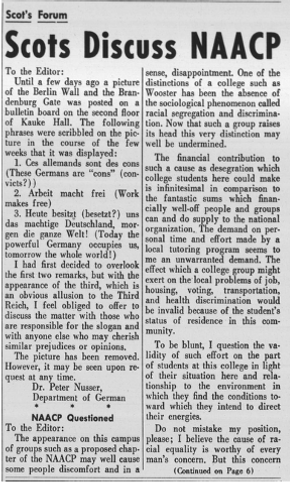
This Wooster Voice article is the 1963 letter to the editor that questions the validity of an NAACP chapter on campus.
Going Community-Wide: The Shift to the Wooster/Orrville NAACP in 1965
When the College chapter closed in 1965 following Mark Denbeaux’s graduation, James Harris took the initiative to start a Wooster/Orrville branch of the NAACP that is still going strong today. The Wooster/Orrville NAACP continued to focus on social and economic justice issues within Wayne County. Lydia Thompson, Dr. Yvonne Williams, and Betty Whitmore were early and integral members of the town branch under James Harris’s leadership as president. With the founding of the local chapter, the Wooster/Orrville NAACP sought to build social justice locally. The group focused on advocating for fair housing for African American residents and raising scholarship funds for Black students on the College of Wooster campus. The NAACP also informed Wooster residents about national ongoings, activism, and civil rights issues through local protests, keynote speakers, and membership drives.

"I don't think it's [the fight for civil rights]ever going to be finished."
James Harris, Oral History (31:25).
Working Towards the Future in a Small Midwest Town
The 1960s brought a piece of the national narrative to Wayne County, Ohio. Housing, job, transportation, and educational discrimination continued into the 1970s, and the Wooster/Orrville NAACP did not shy away from challenging these injustices. While Wooster, Ohio may be a small town in Northeast Ohio, the experiences of its citizens mirror those in communities of all sizes. Building social justice in a small Midwestern town means confronting the transgressions of a close-knit, majority white, community. By challenging discrimination in housing, employment, education, and public life, local activists revealed how systemic inequities operated even in communities that often viewed themselves as welcoming and progressive. The dedicated effort of a sizable group of individuals kept the organization going strong beyond its earliest years and into the present day.

A sign dedicating Rosa Parks Way in Christmas Run Park stands as a testimonial to the work of the Wooster/Orrville NAACP.
Sources and Further Reading
Primary Sources
Columbus Metropolitan Library, Public domain, via Wikimedia Commons.
Dade, Shannon. “Second Baptist in the 1960s · Second Baptist Church · Wooster Digital History Project.”
Woosterhistory.org, 2026. https://woosterhistory.org/exhibits/show/secondbaptist/secondbaptist1960s.
Daily Record, (Wooster, Ohio), October 9, 1968: 16. NewsBank: Access World News – Historical and Current.
Daily Record (Wooster, Ohio), January 27, 1969: 2. NewsBank: Access World News – Historical and Current.Editors, Wooster Voice, "The Wooster Voice (Wooster, OH), 1963-11-08" (1963). The Voice: 1961-1970. 69.
https://openworks.wooster.edu/voice1961-1970/69.
Editors, Wooster Voice, "The Wooster Voice (Wooster, OH), 1963-12-13" (1963). The Voice: 1961-1970. 73. https://openworks.wooster.edu/voice1961-1970/73.
Editors, Wooster Voice, "The Wooster Voice (Wooster, OH), 1964-10-09" (1964). The Voice: 1961-1970. 89. https://openworks.wooster.edu/voice1961-1970/89.
Editors, Wooster Voice, “Secret Huddle Are Held Regarding New Voting Law”, Daily Record (Wooster, Ohio), 1965- 03- 15" (1965). The Voice: 1961-1970.
Editors, Wooster Voice, "The Wooster Voice (Wooster, OH), 1965-03-12" (1965). The Voice: 1961-1970. 104. https://openworks.wooster.edu/voice1961-1970/104.
Editors, Wooster Voice, "The Wooster Voice (Wooster, OH), 1966-03-11" (1966). The Voice: 1961-1970. 127. https://openworks.wooster.edu/voice1961-1970/127.
Editors, Wooster Voice, "The Wooster Voice (Wooster, OH), 1967-03-24" (1967). The Voice: 1961-1970. 149. https://openworks.wooster.edu/voice1961-1970/149.
Editors, Wooster Voice, "The Wooster Voice (Wooster, OH), 1968-10-18" (1968). The Voice: 1961-1970. 179. https://openworks.wooster.edu/voice1961-1970/179.
Editors, Wooster Voice, “James Harris As President”, Daily Record (Wooster, Ohio), 1969- 08- 27" (1969). The Voice: 1961-1970.
Gregory, James. “NAACP Branch Activities 1912-1923 and Database of Branches 1912-1964 - Mapping American Social Movements Project.” depts.washington.edu, 2006. https://depts.washington.edu/moves/NAACP_map-early.shtml.
Harris, James. James Harris Oral History Interview. Interview by Mady Noble, Beatrice Adams, and Greg Shaya. The Wooster Digital History Project: The College of Wooster, 2023.
Jackshiv0001, CC BY-SA 4.0 <https://creativecommons.org/licenses/by-sa/4.0>, via Wikimedia Commons.
Kaufman, Alma. “Wooster Negro Buys a Home – Ten-Year Story Has a Happy Ending,” The Daily Record, July 13, 1964.
____ “Housing is Rated Number One Problem of Wooster’s Negroes,” The Daily Record, July 11, 1964.
Morgan, Emily. “Model of Determination-Remembering Virginia.” The Daily Record. March 13, 2021.
“NAACP to Start Drive on Membership,” Daily Record, (Wooster, Ohio), January 27, 1968: 2. NewsBank: Access World News – Historical and Current.
Second Baptist Church, “Reverend Leroy Adams with his Family,” Wooster Digital History Project, accessed June 10, 2026, https://woosterhistory.org/items/show/151.
Thompson, Lydia. Lydia Thompson Oral History Interview. Interview by Lawrence Walker and Greg Shaya. Wooster Digital History Project: The College of Wooster, 2022.
Williams, Yvonne. Yvonne Williams Oral History Interview on Wooster History. Interview by Greg Shaya, Mady Noble, and Aaron Huq. The Wooster Digital History Project: The College of Wooster, 2022.
Secondary Sources
Berg, Manfred, and John David Smith. The Ticket to Freedom: The NAACP and the Struggle for Black Political Integration. University Press of Florida, 2005.
Sullivan, Patricia. Lift Every Voice : The NAACP and the Making of the Civil Rights Movement. New Press, 2009.