
1980s: The National Story Comes to Wooster
Written by Haruka Ueda & Abby Frock. Edited by Jordan Biro Walters, PhD and Elora Agsten, MSLIS.
The Wooster/Orrville NAACP was an important facilitator for promoting dialogue about racial equality throughout the community. It expanded its activism and increased awareness by connecting with other NAACP branches and prominent figures. During Black History Month in 1989, the Wooster/Orrville NAACP organized a weekly lecture series featuring guest speakers on topics related to Black history. Speakers included Terry Kershaw, Professor of Sociology at the College of Wooster, Judge Shirley Strickland Saffold of the Cleveland Municipal Court, and a panel of local teachers.
Rosa Parks in Wooster, Ohio
Another important facilitator for change was The Freedom Fund Banquet. The event is a dinner and fundraiser for the Wooster/Orville NAACP’s continued civil rights activities. The Banquet also recognizes achievements in the Civil Rights Movement each year. One of the most notable guest speakers in the 1980s was Rosa Parks. She is recognized as the “Mother of the Civil Rights Movement” for spearheading a year-long Montgomery Bus Boycott in Alabama after refusing to give up her bus seat to a white man. Wooster/Orrville NAACP member Lydia Thompson was responsible for bringing Rosa Parks to Wooster.

NAACP Meeting Discussing the Invitation of Rosa Parks
(Image courtesy of Wooster Public Library).
Before the boycott, Parks worked as an active member of the NAACP in Alabama, investigating cases of racial injustice and advocating equal rights. In 1944, she helped organize the Committee for Equal Justice for Recy Taylor, a Black woman who survived a sexual assault. The committee recruited supporters across the U.S., and it was later called the “strongest campaign for equal justice to be seen in a decade.”
Her lifelong commitment to social justice continued through her work with the NAACP and alongside leaders such as Dr. Martin Luther King Jr. The Midwest was not an exception to her impact. Her visit to the Freedom Fund Banquet in Wooster was meaningful to many residents, as it acknowledged the efforts of the Civil Rights Movement. Her visit also highlighted that people across the nation worked toward the same goals. In 2002, Wooster’s City Council legislated to name an unnamed road through Christmas Run Park “Rosa Parks Way” in honor of her contribution to justice.

Rosa Parks Avenue: 143 Park Ave Wooster, OH 44691
(Wooster Digital History Project).
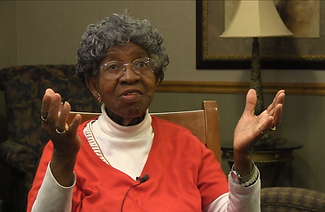
Marching for Martin Luther King Jr. Day
The Wooster/Orrville NAACP participated in regional and national issues. Former branch president and founder James Harris described one of the major highlights from the time of his leadership as a national campaign accomplished in the 1980s. The national NAACP organized a campaign to collect one million signatures in support of establishing Martin Luther King Jr.’s birthday as a national holiday. Harris and the Wooster/Orrville NAACP participated in a series of marches from Cincinnati to Columbus to mark Martin Luther King Jr. Day. These marches were organized by the Cincinnati NAACP chapter as a part of the larger national campaign. Martin Luther King Jr. Day was finally recognized as a national holiday in 1986.

Dr. Martin Luther King Jr. at the 1963 March on Washington. Image courtesy of Wikimedia Commons.
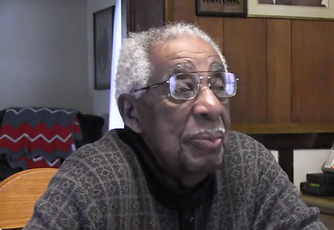
When James Harris was asked about the most influential thing the NAACP did for the Wooster/Orrville community, he said “Just being here was the most important thing.” James Harris significantly contributed to fighting racial discrimination on a regional scale.
" Just being here was the
most important. "
- James Harris Oral History (52:04)
The Fight for Equitable Education in Northeast Ohio
Cleveland City Schools
During the 1980s, educational institutions confronted racial segregation, particularly in public schools, higher education, and faculty representation.
Segregation limited educational opportunities for many Black students. While segregation was not legislated in Cleveland as it was in southern cities, racial divides were marked by geography and neighborhood demographics. Many Black families were concentrated on Cleveland's East Side where there were fewer schools, businesses, and economic opportunities.

Students gather with balloons at Kenneth W. Clement Elementary School on September 29, 1980, the year that desegregation was fully implemented in Cleveland City Schools.
(Image courtesy of Cleveland Civil Rights Trail).
Cleveland City Schools on the East Side suffered from decades of overcrowding while predominantly white schools on the West Side hosted empty classrooms. Legal change occurred in 1980 when U.S. District Judge Frank Battisti ruled that Ohio’s State Board of Education was responsible for maintaining segregation in the school system. It resulted in the court requiring Cleveland City Schools to desegregate. The mandate included a busing plan, which transported students to schools outside their neighborhoods to achieve racial balance, and encouraged open enrollment. Unfortunately, and as in many other Northern cities, formal desegregation was not entirely successful. Many white families left city districts as a part of "White Flight" to Cleveland's developing suburbs. This once again left Cleveland City Schools as a predominantly Black district with fewer resources than predominantly white schools.

Judge Frank Battisti was in charge of the Cleveland public school desegregation case.
(Image courtesy of Cleveland Civil Rights Trail).

A photograph of the first day of school busing.
(Image courtesy of Cleveland Civil Rights Trail).
The College of Wooster and Student Activism
Efforts to address racial inequality also extended to higher education. At the College of Wooster, President Copeland established the Committee on the Quality of Life for Black Students in 1982. The committee aimed to improve the experiences of Black students through increased recruitment, retention, and faculty diversity. Students themselves also became increasingly active in demanding further changes. In 1989, a group of students, led by Mark Goodman, occupied Galpin Hall and presented a list of demands for greater support of Black students. The demands included hiring more Black faculty and increasing financial aid. Goodman now serves as the President of the Board of Trustees at the College of Wooster, beginning in 2025.

Black members of the campus community took action around 7 a.m. on a Thursday in April 1989.
(Wooster Digital History Project).

Students successfully occupied the Galpin Hall and locked the deans and administrators outside.
(Image courtesy of WoosterHistory).
The student movement inspired community involvement. In 1989, President Henry Copeland set a time to invite Black communities to discuss problems and solutions for equal opportunities in the Wooster community. Meanwhile, he requested an increased number of security officers around Beall Avenue to allow people to visit with greater safety. In addition, he requested that faculty devote two class periods to engage students in a discussion about racial discrimination on campus and in the community. The Galpin takeover and the successive changes are strong examples of how a small student community can promote and expand activism to the broader community.
George Forbes and Black Businesses
It was not until the 1980s that Ohio began implementing stronger protections for minority-owned businesses even though President Richard Nixon had issued Executive Order 11458 in 1969 to establish the Office of Minority Business Enterprise. The Ohio state government passed the Minority Business Enterprise Act (House Bill 584) in 1980. With the creation of this legislation, several of Cleveland’s Black political leaders, including George Forbes, the President of the Cleveland City Council, supported affirmative action and set-aside programs for minority businesses. Forbes demanded that entities follow the city’s Equal Employment Opportunity standards when they failed to do so.
George Forbes was the first Black man elected as President of the Cleveland City Council and a founding partner of the first African American law firm in Cleveland. After earning a law degree, he became a strong advocate for Black communities and became one of the most influential Black politicians in Cleveland during the 1980s.

George Forbes (left) and Carl B. Stokes (right), prominent African American leaders in Cleveland whose work in politics and public service contributed to the advancement of civil rights.
(Image courtesy of Cleveland History Center).
A Decade of National and Regional Engagement
The 1980s brought greater social and civil rights improvements across Northeast Ohio. Building social justice in a small Midwest town in the 1980s meant broader engagement with national and regional issues. The Wooster/Orrville NAACP participated at many levels of activism, from the Martin Luther King Jr. Day marches to hosting Rosa Parks in Wooster. In Northeast Ohio, school segregation formally ended and economic opportunities improved for Black residents. Even though the 1980s saw marked progress in education, economics, and civic engagement, racial discrimination persisted. The Wooster/Orrville NAACP continued as a site of activism.

Rosa Parks in the 1990s. Image courtesy of Wikimedia Commons.
Sources and Further Reading
Primary Sources
Brucker, Barb. “‘Freedom Fund’ Banquet for Local NAACP.” Daily Record (Wooster, OH), September 18, 1978, 30.
Brucker, Barb. “‘Still Fighting For Freedom’ Says NAACP Official.” Daily Record (Wooster, OH), September 22, 1979, 9.
Budher, Glenn R. Letter to Colleague, 5 April 1989. Special Collection, The College of Wooster, Wooster, OH.
Colins, Bee. “NAACP Spokesmen Talk With Mayor.” Daily Record (Wooster, Ohio), January 22, 1980.
Copeland, Henry. Letter to Members of the Campus Community, 29 March 1989. Special Collection, The College of Wooster, Wooster, OH.
Daisy Craggett and Clara Smith, “School Rooms,” The Cleveland Plain Dealer, October 20, 1961.
Harris, James. James Harris Oral History. Interview by Mady Noble, Beatrice Adams, and Greg Shaya. The Wooster Digital History Project: The College of Wooster, 2023.
Johnson, E. E. “Mother of Civil Rights Movement Will Speak at Local NAACP Event.” Daily Record (Wooster, OH), May 11, 1989, 1.
NAACP Cleveland Branch. “Freedom Fund Dinner.” n.d. https://clevelandnaacp.org/freedom-fund-dinner/.
Neely, Chanda. “Local NAACP Fund-Raiser Is Saturday.” Daily Record (Wooster, OH), October 24, 2006.
Secrest, Barbara D. “Resident Enjoyed Program Put On By NAACP.” Daily Record (Wooster, Ohio), February 27, 1989.
Spigos, Mark. “NAACP Freedom Fund Dinner on Oct. 11 Raise Money for Local Grads.” Daily Record (Wooster, OH), September 26, 2014.
Staff Writer. “Council to Consider Rosa Parks Way in Park.” Wooster Daily Record, March 31, 2002. https://www.the-daily-record.com/story/news/2002/03/31/council-to-consider-rosa-parks/19609384007/.
Theoharis, Jeanne, Komozi Woodard, and Dayo F. Gore, eds. Want to Start a Revolution? Radical Women in the Black Freedom Struggle. New York: New York University Press, 2009. Chapter 5.
Thompson, Lydia. Lydia Thompson Oral History Interview. Interview by Lawrence Walker and Greg Shaya. The Wooster Digital History Project: The College of Wooster, 2022.
Wikimedia Commons contributors, "File:Civil Rights March on Washington, D.C. (Dr. Martin Luther King, Jr. and Mathew Ahmann in a crowd.) - NARA - 542015 - Restoration.jpg," Wikimedia Commons.
Wikimedia Commons contributors, "File:Rosa Parks 1996.jpg," Wikimedia Commons.
WoosterHistory. “The Galpin Takeover (1989).” Additional information. December 5, 2025. YouTube video, 6:01. https://youtu.be/mA-5C8Jz7Tc.
Secondary Sources
“Desegregation of Cleveland Public Schools - Cleveland Civil Rights Trail.” 2024. Cleveland Civil Rights Trail. February 2024. https://clevelandcivilrightstrail.org/explore-the-trail/desegregation-of-cleveland-public-schools/.
Footlick, Jerrold K. 2015. An Adventure in Education.
House-Soremekun, Bessie. 2009. Confronting the Odds.
McLaughlin, Meghan. 2022. “Desegregating Schools in the North: The Cincinnati Board of Education and the NAACP.” Wittenberg History Journal 42: 53–69. https://wittprojects.net/ojs/index.php/whj/article/view/268.
The HistoryMakers. “The Honorable George Forbes’s Biography,” 2020. https://www.thehistorymakers.org/biography/honorable-george-forbes.
Wickliffe, Bryan. 2026. “Segregation in Columbus, Ohio Did It Ever Leave.” Open Works. 2026. https://openworks.wooster.edu/independentstudy/3871/.
Williamson, Terrion L. Black in the Middle: An Anthology of the Black Midwest. Cleveland, Ohio Best Publishing, 2020.